Preparing a Firearm Insurance Inventory Before You Need to Make a Claim
Even with careful storage of firearms and related gear, accidents can happen and items can be lost or even stolen. Attempting to rebuild a lost item after it has been damaged or stolen can be a time-consuming and onerous process, and often will rely on incomplete documentation. This can turn a simple loss into a lengthy and potentially stressful exercise in guesswork. With some simple prior planning in the form of a relatively modest and private inventory of your firearms and related gear, the owner can be fully prepared to make a claim in the event of a loss.
Start with an item-by-item record
Start with the items in your collection that your policy will cover (guns, maybe optics, suppressors where permitted, cases, scopes, sighting devices, range finders, binoculars, tripods, reloaders, loader, scales, powder measures, presses, accessories, etc.). Do not assume all items related to a gun will be covered by the same limits. Read your policy carefully and ask your insurer for clarification on the categories of property that will be covered as scheduled items.
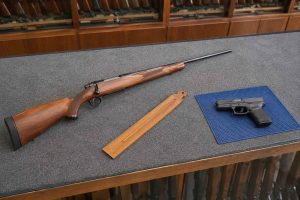
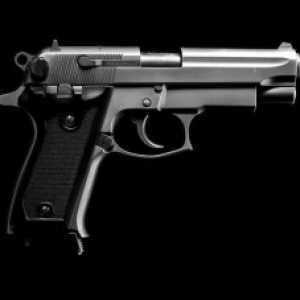
The same sort of detail should be documented for each rifle, shotgun, hand gun, and even ammunition, optic, suppressor, case, reloader, reloading component,_scope_, and other such firearm related accessories. The detail in the illustration to the left shows the sort of detail that should be included in documentation for each item. Here, the illustration includes model number, finish, location of engravings, distinctive wear, etc.
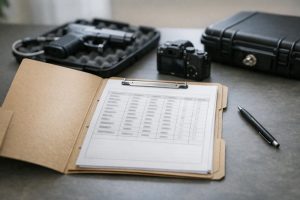
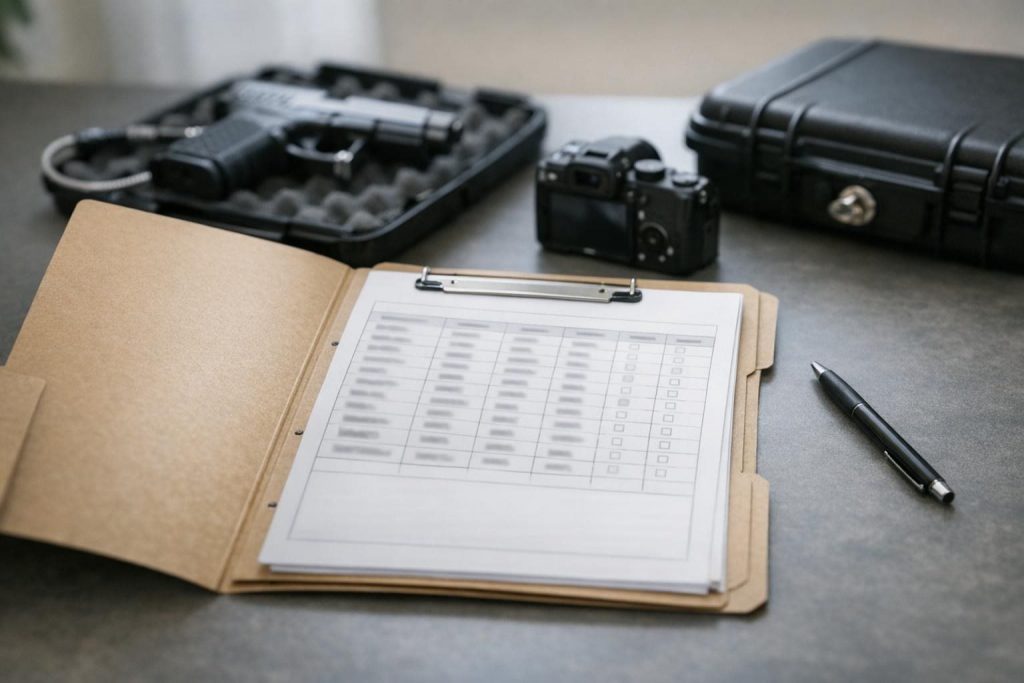
A spreadsheet is generally the most suitable format to create a home inventory because you can search for items and update it from time to time. Alternatively, you can create a paper worksheet and store it in a fireproof safe or in a secure location away from your home. During a power outage, for instance, a paper worksheet would be more convenient to review from stored documents than a computerized spreadsheet.
Photograph the details that matter
Be sure to take photographs of items, including full views of each item and close-ups of the serial number as well as any distinctive features or marks. Ensure that there is enough light in the photo to be able to read the characters, and verify that you have taken an adequate photo immediately after taking the shot.
You take photos of major accessories when they have high value or you are unsure of their ownership. The single group photo shows what you have stored together, and the individual photos better document each item. It's better to keep the original files rather than to send compressed copies via messaging apps, because they may degrade in quality.
Your collection is private. Do not create a public on-line photo album for your firearms. For instance, don't post photos of your serial numbers or where you store your firearms in your home. Before creating an online record of your scheduled property for recordkeeping purposes, make sure it will serve a legitimate purpose and not get you into trouble.
Gather receipts without relying on them alone
Receipts are a form of evidence but may be missing, destroyed, or become too old to recognize. Other documentation such as a bill of sale, transfer papers, a dealer record, an appraisal, service records, etc. can aid in proving ownership of a firearm. Keep a copy of original documentation and indicate where the originals are stored.
Keep copies of original documents even if you maintain the original document. Document where original copies are stored. Try to fill out as much information as possible for privately acquired items (not purchased from a retailer) including the date and circumstances of the transfer. Be aware that there are laws and recordkeeping requirements governing such information and they can change. Seek out current information from appropriate jurisdiction government websites and/or contact someone who is qualified to give information regarding such matters.
As for value, the amount that one paid for an item is not necessarily the same amount that an insurer will pay for said lost article. More often than not, an item is covered for either the replacement cost or the actual cash value, and other items such as ammunition, accessories, etc. might be covered as scheduled property, and sometimes subject to a deductible or excluded entirely. Before an item is lost, ask for a list of covered items and their corresponding values and store that info with your policy documents.
Build a private backup system
A useful collection of documents is only as good as the container that holds them. Keep a copy of the documents you have listed and store them in a safe place that is not in the same location as the items detailed. Consider an external hard drive, USB memory stick, online storage like Dropbox etc.
A good password is one that is not easily guessable. This is particularly the case for a file containing information such as the serial numbers of your guns, copies of your receipts for purchase of home related items, photographs of your guns and other items, and other similar data. Use of a password on a file such as this should not be something that can be easily figured out by another member of your household.
Check your records after a purchase, sale, transfer or major repair of a gun or other home-related item, and update your records after a move to a new storage location. Small updates over time are so much easier than trying to re-create years of prior records. Clearly note which items have been sold or moved and retain prior records to help establish a history of a gun or scheduled item that was purchased years prior.
Make the record usable during a claim
However, you must maintain the original inventory in its "as-is" state for a claim. You can then make work copies for notes, etc. Track the date you discovered the loss, who you notified and what documentation and images you provided to the company. Carefully follow the claim instructions of your insurance company and maintain copies of all submitted documentation.
Don't discard packaging or other evidence of a loss for an insurance claim until you are advised that you can by the insurer. In a theft, seek help from the police. As suspected loss by criminal activity report the matter to the relevant authorities. Note that procedures and reporting for claims can vary for each insurer and therefore seek out the current procedure and what is required for a claim to be processed in good time.
Creating a comprehensive documentation package does not guarantee payment of a claim. Insurance policies have many intricacies and documentation can sometimes become an afterthought. A thorough, private and continually-updated inventory will render the greatest assistance should an unforeseen event occur and related details become indeterminable.